September has been declared by Gov. Charlie Baker to be Emergency Preparedness Month. Residents are encouraged to use resources provided by the Massachusetts Emergency Management Agency (MEMA) to prepare themselves, their family, their property and their community for an emergency or natural disaster.
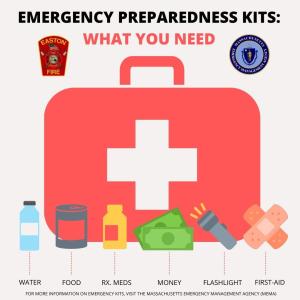 Emergency plans and kits should include everyone in your household including individuals with access and functional needs, seniors, children, infants and pets. Consider any additional supplies needed for basic survival and familiarizing yourself with the emergency plans that are in place at your workplace, children’s school or daycare or other places where your family spends time.
When creating family emergency plans and kits, residents should take into consideration the ongoing COVID-19 pandemic. Residents should add items such as face coverings/masks, disinfectants, hand sanitizer and other cleaning supplies to their emergency kits. Residents should also identify emergency contacts who aren’t immunocompromised and meeting locations where families can maintain adequate physical distance from one another.
MEMA offers several tips to make an emergency plan for your family:
[sp_easyaccordion id=”1179″]
Also, as a part of Emergency Preparedness Month the Easton Fire Department encourages families to build an emergency kit. MEMA recommends that emergency kits include essential items that will provide your family members with basic necessities for up to three days in an emergency event.
Essential Items to Include in an Emergency Kit:
- Water: Bottled water (one gallon per person/per day for at least three days), water purification tablets
- Food: At least a three-day supply of non-perishable foods that do not need cooking (ready-to-eat canned meats, fruits or vegetables, or juices, protein or granola bars, cereal, peanut butter, dried fruit, nuts, crackers, baby food and comfort foods)
- Tools and Supplies: Manual can opener, radio (powered by battery or hand crank), flashlight or lantern, extra batteries, cell phone with charger, wrench, pliers and other basic tools
- Personal Items: Prescription medications (two-week supply), personal hygiene items, eyeglasses, contact lenses, dentures, extra batteries or supplies for medical equipment, change of clothes, sturdy shoes
- Documents: Insurance policies, bank account records, identification cards (IDs), medical information and other copies of important documents
- Money: Extra cash and traveler’s checks (ATMs may not work during a power outage)
- Other Items: First-aid kit, emergency whistle, waterproof matches/lighter, local area maps, sleeping bags or blankets, comfort items such as books or games
- Also consider: A watch or clock, disposable kitchenware, duct tape, plastic sheeting or tarp to protect against the elements
MEMA also offers an Emergency Kit Checklist to assist families in building a kit of their own.
 Easton Fire Department